
Last Update: June 9, 2026
Dubai is built for big first impressions: glass towers, desert highways, beach clubs, gold souks, air-conditioned malls, Michelin-listed restaurants, family attractions, futuristic transport and hotels that range from simple airport stays to some of the world’s most famous luxury resorts.
It is also a destination where practical details matter. Visa rules depend on your passport. DXB is easy to use, but airport traffic can be heavy. The metro is clean and useful, but it does not reach every beach or resort. Summer heat is extreme. UAE laws around alcohol, drugs, social behaviour, photography, online posting and medicines are stricter than many visitors expect. In 2026, official travel advisories also need to be checked carefully because regional escalation has affected security guidance and flights.
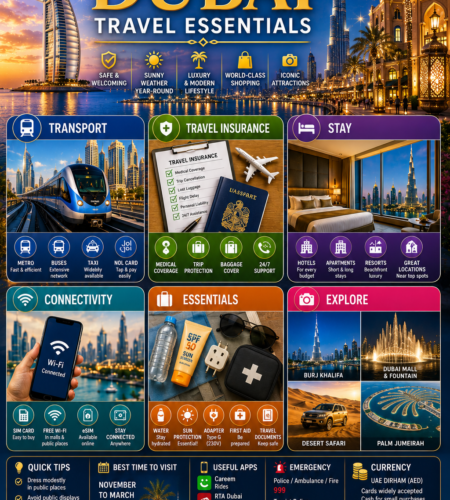
This Dubai travel essentials guide gives visitors a structured foundation before arrival: UAE entry rules, visa basics, DXB airport transfers, Dubai Metro, nol cards, taxis, where to stay, money, VAT, tourist taxes, safety, local laws, health, tap water, mobile data, weather, packing, day trips, car rental and essential contacts.
All prices are in UAE dirhams (AED). Rules, fares, hotel fees, airport procedures, security advisories, entry restrictions, health rules and service hours can change. Always confirm final details with official UAE government portals, GDRFA Dubai, ICP, Dubai Airports, RTA, Visit Dubai, Dubai Police, Federal Tax Authority, your airline and your own government’s travel advisory before travelling.
Current Travel Advisory Note
As of June 9, 2026, this article is written with a safety-first approach.
The UK FCDO page checked on June 9, 2026 states that it advises against all but essential travel to the United Arab Emirates. The U.S. Department of State lists the UAE at Level 3: Reconsider Travel, citing armed conflict and terrorism risks. Government of Canada travel advice warns that regional tensions, terrorism, missile strikes and drones can affect the UAE and that commercial flights may face short-notice disruption.
This does not mean every traveller will cancel. It does mean Dubai content should not read like ordinary evergreen travel inspiration without context. Before booking or departing:
- Check your own government’s current UAE travel advisory.
- Check whether your travel insurance remains valid.
- Verify your flight directly with your airline before going to the airport.
- Keep your phone charged and active.
- Follow local authority instructions immediately.
- Avoid posting or sharing unofficial crisis content online.
- Have a plan if flights are delayed, cancelled or rerouted.
This guide is practical information, not a recommendation to travel against official advice.
Quick Answer: Dubai Essentials
Dubai’s main airport is DXB Dubai International Airport. It has direct Dubai Metro Red Line access from Terminal 1 and Terminal 3.
The easiest budget airport transfer is the Dubai Metro if you arrive during operating hours and your hotel is near a station.
Dubai Airports lists Red Line operating hours from DXB as:
- Monday to Thursday: 5AM to midnight
- Friday: 5AM to 1AM the next day
- Saturday: 5AM to midnight
- Sunday: 8AM to midnight
The simplest airport transfer with luggage is an official taxi. Dubai Airports says Dubai Taxi Company taxis are available 24/7 at designated ranks in each terminal and that the airport taxi starting fare is AED 25, with distance-based charges after that.
Dubai public transport uses the nol card. RTA says Dubai is divided into 7 fare zones. For Silver nol card journeys, official RTA fare examples are:
- Within 1 zone: AED 3
- 2 adjacent zones: AED 5
- More than 2 zones: AED 7.50
RTA says travellers need at least AED 7.50 on a nol card to check in.
UAE visa rules depend on nationality. Some passport holders receive visa on arrival. Others need a pre-arranged visa through official channels, airlines, hotels, travel agencies or sponsors. Passports generally need at least 6 months validity for UAE entry.
Dubai uses the UAE dirham, abbreviated AED. The exchange rate is commonly treated as about AED 3.67 to USD 1 because the dirham is pegged to the U.S. dollar, though card and exchange fees vary.
UAE VAT is 5%. Tourists can claim VAT refunds on eligible purchases through the official Tourist Refund Scheme if conditions are met.
Hotels in Dubai may charge tourism-related fees, including the Tourism Dirham Fee per room per night, usually for a maximum of 30 consecutive nights.
Emergency numbers in the UAE:
- Police: 999
- Ambulance: 998
- Fire: 997
- Coastguard: 996
Dubai tourist police contact listed by UAE tourism/emergency guidance: +971 4 609 6239.
Best months for most visitors: November to March.
Most difficult months for outdoor sightseeing: June to September, especially July and August.
Dubai at a Glance
City: Dubai
Emirate: Dubai
Country: United Arab Emirates
Main airport: DXB Dubai International Airport
Secondary airport: DWC Al Maktoum International Airport
Main public transport authority: Roads and Transport Authority (RTA)
Main transit card: nol card
Currency: UAE dirham (AED)
Language: Arabic is the official language; English is widely used in hotels, restaurants, malls, taxis and tourism.
Electricity: 230V, Type G plugs, same plug type as the UK.
Emergency: 999 police, 998 ambulance, 997 fire.
Tap water: DEWA supplies potable water, but many visitors prefer bottled or filtered water due to taste and building tank uncertainty.
Travel style: City break, beach, luxury hotels, family attractions, shopping, desert experiences, food, architecture, stopover travel, warm winter sun.
Entry Rules, Visa on Arrival and Passport Basics
Passport validity
For UAE entry, visitors should generally travel with a passport valid for at least 6 months after arrival. This is stated in major government and airline guidance, including GOV.UK and Emirates visa information.
Transit-only rules may differ if you do not pass immigration, but airlines can apply their own boarding checks. Confirm with your airline before travel.
Practical checklist:
- Passport valid for at least 6 months.
- At least one blank page if you need an entry stamp.
- Machine-readable passport.
- Correct visa or visa-on-arrival eligibility.
- Return or onward flight.
- Hotel address.
- Travel insurance details.
- Documents for children if travelling with minors.
- Medicine documents if carrying prescriptions.
Visa on arrival
Many nationalities receive a visa on arrival in the UAE. The length and conditions vary by passport.
Common visa-on-arrival categories include:
- 30-day eligibility for selected nationalities
- 90-day eligibility for selected nationalities
- 180-day eligibility for Mexican passport holders, according to Emirates visa information
- Special categories for certain Indian citizens holding valid U.S., UK or EU residence/visa documents, subject to conditions
Do not rely on a blog list alone. Visa-on-arrival eligibility changes and airline staff may check before boarding.
Check:
- UAE government portals
- GDRFA Dubai
- ICP
- Your airline
- UAE embassy or consulate guidance
Pre-arranged tourist visa
If your passport is not eligible for visa on arrival, you may need a pre-arranged tourist visa.
Official and high-reliability channels include:
- GDRFA Dubai for Dubai-issued entry permits
- ICP for federal UAE services
- UAE airlines and approved travel partners
- UAE-based hotels or travel agencies where applicable
GDRFA Dubai lists tourist visa services including single-entry tourist visas and multi-entry options. GDRFA describes single-entry tourist visas as available for tourism for 30 or 60 days, subject to sponsorship/host and fee requirements.
Five-year multi-entry tourist visa
The UAE also has a five-year multi-entry tourist visa category. GDRFA Dubai lists requirements such as:
- Personal photo
- Passport copy valid for at least 6 months
- Six months bank statement
- Health insurance
- Round-trip ticket
This visa is not necessary for most short city breaks, but it may be useful for frequent UAE visitors.
Do not overstay
Overstaying can create fines and future immigration issues. If you want to extend your stay, check directly with GDRFA Dubai or ICP before your authorised stay expires.
Working on a tourist visa
Do not work on a visit or tourist visa unless you have the correct permit. Official foreign travel advice warns that working on a visit visa can lead to fines, prison sentences or deportation.
Current Entry and Health Alerts
Entry and health measures can change quickly.
As checked from Emirates travel updates, UAE entry restrictions effective June 6, 2026 state that the UAE will not allow entry to travellers who have recently been in the Democratic Republic of Congo, Uganda or South Sudan unless they have been outside those countries for more than 21 days. Travellers transiting through the UAE must also comply with the entry measures of their final destination.
Because this type of rule can change at short notice:
- Check your airline’s travel updates.
- Check UAE government entry pages.
- Check whether your route includes transit restrictions.
- Confirm health documentation if you recently visited affected countries.
Arrival Airport: DXB Dubai International
DXB is one of the world’s busiest international airports and the main gateway for Dubai visitors.
DXB terminals
DXB has three passenger terminals:
- Terminal 1: many international airlines
- Terminal 2: regional and low-cost flights, including many flydubai services
- Terminal 3: Emirates and selected partner operations
Metro access is available at Terminal 1 and Terminal 3. Terminal 2 is not directly on the metro.
DXB to hotel: best options
| Option | Best for | Notes |
|---|---|---|
| Dubai Metro | Budget travellers, light luggage, hotels near stations | Direct from Terminals 1 and 3 |
| Official taxi | First-time visitors, late arrivals, luggage, families | 24/7 airport ranks; starting fare AED 25 |
| Ride-hailing | App users, direct transfer | Uber, Careem and Bolt are available |
| Hotel transfer | Resort stays, luxury trips, families | Often expensive but easy |
| Rental car | Road trips, Abu Dhabi, desert resorts | Not needed for many city stays |
Metro from DXB
Dubai Airports says the Dubai Metro Red Line connects DXB Terminals 1 and 3. The metro is clean, air-conditioned and usually the best-value option if:
- Your hotel is near a Red Line station.
- You arrive during operating hours.
- You have manageable luggage.
- You are comfortable with escalators, station walking and transfers.
Dubai Airports notes that passengers should travel light with up to two pieces of luggage, including hand luggage, and consult RTA for detailed luggage restrictions.
Taxi from DXB
Dubai Airports says Dubai Taxi Company taxis are available 24/7 at designated ranks in each terminal. The airport starting fare is listed as AED 25, with additional distance-based charges.
Use taxis when:
- You arrive after metro hours.
- Your hotel is far from a station.
- You have heavy luggage.
- You are travelling with children.
- You are staying on Palm Jumeirah, Jumeirah Beach, Dubai Creek Harbour or a resort area.
Ride-hailing from DXB
Dubai Airports states that Uber, Careem and Bolt are available. Book in the app and follow airport signage to the pickup point.
Ride-hailing can be useful, but compare live prices with the official airport taxi queue. During peak hours, events or disruption, app prices can rise.
Airport Wi-Fi and SIM/eSIM
DXB has free airport Wi-Fi and telecom shops. However, a pre-arranged eSIM is often simpler because it works as soon as your phone connects after landing.
DXB timing tips
Give yourself extra time when:
- Travelling during regional disruption
- Travelling during holidays
- Flying from Terminal 3 at busy Emirates departure waves
- Using road transfer at peak traffic times
- Checking bags for long-haul flights
Always check your airline before travelling to the airport if flights are being disrupted.
DWC and Other Airport Notes
DWC Al Maktoum International Airport is Dubai’s secondary airport, located farther south. It is used for selected passenger operations, charter flights, cargo and future expansion.
Dubai Airports notes that guests can connect to DWC via RTA buses or taxis from Ibn Battuta and Expo 2020 Metro Stations, and that journey planning is available through RTA’s S’hail app.
If your ticket says DWC instead of DXB, do not assume it is the same airport. DWC can take much longer from central Dubai, Dubai Marina or old Dubai depending on traffic.
Best Time to Visit Dubai
November to March
This is the best season for most visitors.
Expect:
- Warm days
- Cooler evenings
- Better beach weather
- Outdoor dining
- Desert tours
- Festivals and events
- Higher hotel prices
Good for:
- First-time visitors
- Families
- Couples
- Outdoor sightseeing
- Desert safari
- Beach trips
- Stopovers
April and May
These months are warmer but still manageable for many travellers, especially if you plan outdoor activities early and spend afternoons indoors.
Expect:
- Rising heat
- Better hotel deals than peak winter in some periods
- Good pool weather
- Shorter outdoor walking windows
June to September
Summer is intense. Heat and humidity can be difficult, and outdoor sightseeing during the day can be unsafe for some travellers.
Expect:
- Extreme heat
- Very hot nights
- High humidity near the coast
- Heavy air-conditioning indoors
- Lower hotel prices in some categories
- More indoor-focused itineraries
Summer tips:
- Do outdoor sightseeing at sunrise or after sunset.
- Use taxis more often.
- Hydrate constantly.
- Avoid long exposed walks.
- Choose hotels with strong pool and indoor facilities.
- Plan malls, museums, spas, restaurants and indoor attractions.
October
October is a transition month. It can still be hot, but evenings become more comfortable.
Ramadan
Ramadan dates change each year. Dubai remains visitable during Ramadan, but visitors should be respectful.
During Ramadan:
- Dress modestly.
- Avoid eating, drinking, smoking or chewing gum in public during daylight in ways that cause offence.
- Check restaurant and attraction hours.
- Expect a beautiful evening atmosphere around iftar.
- Be patient at sunset traffic times.
Where to Stay: Best Areas
Dubai is spread out. Choosing the right area matters more than choosing the “best hotel” in isolation.
Downtown Dubai
Best for:
- Burj Khalifa
- Dubai Mall
- Dubai Fountain
- First-time visitors
- Short stays
- Luxury city hotels
Pros:
- Iconic sights nearby
- Easy taxi access
- Metro connection via Burj Khalifa/Dubai Mall station
- Good restaurants and shopping
Trade-offs:
- Hotel prices can be high.
- Walking distances can feel longer than they look.
- Traffic can be heavy around Dubai Mall.
Dubai Marina and JBR
Best for:
- Beach and city mix
- Nightlife
- Restaurants
- Apartments
- Marina walks
- Families and couples
Pros:
- Beach access
- Tram and metro connections
- Many hotels and restaurants
- Lively evening atmosphere
Trade-offs:
- Traffic can be slow.
- It is far from old Dubai and DXB compared with Downtown.
Palm Jumeirah
Best for:
- Resorts
- Families
- Luxury stays
- Beach clubs
- Honeymoons
Pros:
- Resort feeling
- Atlantis and beach hotels
- Strong pool and family facilities
Trade-offs:
- You will use taxis often.
- It is less convenient for old Dubai, souks and metro.
Jumeirah Beach and Umm Suqeim
Best for:
- Beach
- Burj Al Arab views
- Family-friendly stays
- Quieter coastal feel
Trade-offs:
- Metro access is limited.
- Taxis or rental cars are more useful.
Business Bay
Best for:
- Modern hotels
- Downtown access
- Slightly better value than Downtown in some periods
- Business trips
Business Bay works if your hotel has good taxi access and you do not mind being slightly away from the main tourist cluster.
Deira and Bur Dubai
Best for:
- Old Dubai
- Souks
- Creek
- Budget stays
- Food
- Culture
- Transit access
Pros:
- More historic feel
- Better budget options
- Close to DXB
- Metro and abra access
- Excellent casual food
Trade-offs:
- Less beach/resort atmosphere.
- Some areas feel busy and commercial.
Dubai Creek Harbour
Best for:
- Newer hotels
- Skyline views
- Quieter waterfront stays
Trade-offs:
- More taxi-dependent.
- Less convenient for first-timers without a car or app rides.
Near DXB
Best for:
- Overnight layovers
- Early flights
- Business near airport
Do not stay near DXB if your goal is a beach holiday or first-time sightseeing unless budget or flight timing makes it necessary.
Hotel partner placement
Dubai hotel prices vary heavily by season, location, event dates and room type. Compare areas before booking, not just star ratings. A practical starting point is to compare Downtown, Dubai Marina/JBR, Palm Jumeirah, Deira/Bur Dubai and airport hotels on Expedia, then check the exact location against metro stations and taxi times.
Getting Around Dubai
Dubai is easy to move around if you combine the right tools:
- Metro for airport, Downtown, malls and Marina corridors
- Tram for Dubai Marina and JBR
- Taxis for beaches, resorts, late nights and heat
- Ride-hailing for direct app-based transfers
- Buses for budget travel and gaps
- Abra for Dubai Creek
- Rental car for Abu Dhabi, desert resorts and multi-emirate road trips
Most visitors use a mix of metro and taxi.
Metro
The Dubai Metro is clean, automated, air-conditioned and excellent for long north-south trips.
Useful stations:
- Airport Terminal 1
- Airport Terminal 3
- Union
- BurJuman
- Dubai Mall/Burj Khalifa
- Business Bay
- Mall of the Emirates
- Dubai Internet City
- Sobha Realty
- DMCC
- Ibn Battuta
- Expo 2020
Metro limitations:
- It does not reach every beach.
- Walking from station to final destination can be long.
- Summer heat makes “10-minute walks” feel much harder.
- Some attractions need taxi from the nearest station.
Tram
Dubai Tram is useful around Dubai Marina, JBR and the connection toward Palm Jumeirah Monorail.
Buses
Dubai buses cover many areas but are slower than metro for tourists. They are useful for gaps, especially when planned through S’hail or Google Maps.
Abras and marine transport
A traditional abra ride across Dubai Creek is one of the best low-cost experiences in the city. RTA marine services and tourist boats also connect selected waterfront areas.
Taxis
Taxis are widely available and often necessary. Official Dubai taxis are regulated, metered and usually reliable.
Use taxis for:
- Late-night hotel returns
- Beaches
- Palm Jumeirah
- Desert tour pickup coordination
- Family travel
- Hot afternoons
- Luggage
Ride-hailing
Uber, Careem and Bolt operate in Dubai. Careem is especially common locally.
Use app rides when:
- You need a clear pickup point.
- You want card payment through app.
- You want to compare vehicle classes.
- You are in an area with limited street taxis.
Dubai Metro, nol Cards and RTA Fares
What is a nol card?
RTA says a nol card is a smart card that enables passengers to pay for Dubai Metro, buses, Dubai Tram and marine transport with one tap. It can also be used for RTA paid parking and some retail payments.
For tourists, the most useful options are usually:
- Silver nol card
- Red ticket for occasional trips
- Gold nol card if you want Gold Class cabins
nol card prices
RTA’s nol card information lists:
- Silver card: AED 25 including AED 19 balance
- Gold card: AED 25 including AED 19 balance
- Red ticket: AED 2, loaded with up to 10 single trips
- Personal/Blue card: AED 70 including AED 20 balance, more useful for residents or concession categories
Minimum balance
RTA says you should ensure your nol card has a minimum balance of AED 7.50 before checking in.
Fare zones
Dubai is divided into 7 zones. RTA says fares are calculated by the total number of zones travelled and can include transfers between metro and bus if transfer rules are followed.
Silver card fare examples:
| Journey type | Silver nol fare |
|---|---|
| Within 1 zone | AED 3 |
| 2 adjacent zones | AED 5 |
| More than 2 zones | AED 7.50 |
Gold card fare examples:
| Journey type | Gold fare |
|---|---|
| Within 1 zone | AED 6 |
| 2 adjacent zones | AED 10 |
| More than 2 zones | AED 15 |
Red ticket fare examples:
| Journey type | Red ticket regular |
|---|---|
| Within 1 zone | AED 4 |
| 2 adjacent zones | AED 6 |
| More than 2 zones | AED 8.50 |
Transfer rules
RTA states that transfers across different public transport modes are possible if the transfer is made within 30 minutes. RTA’s fare page also lists a maximum journey duration of 180 minutes and up to 3 transfers.
Practical meaning:
- Tap out correctly.
- Transfer within 30 minutes.
- Use the same nol card.
- Do not forget to tap out, or you may be charged more.
Metro etiquette
Remember:
- Use the correct cabin.
- Gold Class is only for Gold fare users.
- Women and children cabins are marked.
- Do not eat or drink on trains.
- Keep luggage controlled.
- Stand aside before boarding.
- Tap in and tap out every time.
Money, Cards, VAT, Tourist Tax and Tipping
Currency
Dubai uses the UAE dirham (AED). The dirham is commonly treated as pegged at about AED 3.67 to USD 1.
Cards are widely accepted. Apple Pay and Google Pay are common. Cash is still useful for:
- Small shops
- Tips
- Traditional markets
- Abras
- Small taxis if terminal issues occur
- Souk bargaining
ATMs and exchange
Use bank ATMs and licensed exchange houses. Airport exchange is convenient but may be less competitive.
If a card terminal asks whether to pay in AED or your home currency, AED is usually better because dynamic currency conversion can be expensive.
VAT
The UAE standard VAT rate is 5% on many goods and services.
Tourists may be able to recover VAT on eligible retail purchases through the official Tourist Refund Scheme. See the VAT refund section below.
Hotel taxes and Tourism Dirham
Dubai hotel bills can include several charges. One important visitor-facing charge is the Tourism Dirham Fee.
Dubai DET’s Tourism Dirham resolution describes the Tourism Dirham Fee as charged for each hotel room night of the main guest for a maximum of 30 consecutive nights.
UAE government guidance says Dubai hotels charge a Tourism Dirham Fee per room per night. Rates depend on hotel category and property type.
Budget advice:
- Read the full hotel price breakdown before booking.
- Check whether taxes and fees are included.
- Expect Tourism Dirham at checkout or included in final booking price depending on platform.
- Ask the hotel directly if unclear.
Tipping
Tipping is appreciated but usually not as aggressively expected as in North America.
Practical guide:
| Situation | Typical tip |
|---|---|
| Restaurant with good service | 10% to 15% if service charge not enough or service was strong |
| Cafe | Round up or small amount |
| Taxi | Round up to next AED 5 or 10 |
| Hotel porter | AED 5 to 10 per bag |
| Housekeeping | AED 10 to 20 per day |
| Tour guide | AED 20 to 50+ depending on length and quality |
| Delivery | AED 5 to 10 |
Many restaurants include service charges, but not all charges go directly to staff. Tip based on service and your budget.
VAT Refund for Tourists
The UAE Federal Tax Authority operates a tourist VAT refund scheme through Planet Tax Free.
Official FTA guidance checked June 9, 2026 states key conditions including:
- The tourist should have entered the UAE on a tourist visa.
- The tourist must be 18 years or older and not resident in the UAE.
- Tax-free transactions must be export validated within 90 days from the date of the tax invoices at departure.
- Tourists must physically present tax invoices, tax-free tags and relevant goods for inspection if requested.
- Tourists may request a refund within one year from export validation.
- The maximum VAT refund claimable in cash is AED 35,000.
- There is no limit on refund claimed through credit/debit card.
- Purchases must be made at retailers registered with Planet under the Tourist Refund Scheme.
Practical steps:
- Shop at a participating retailer.
- Ask for a tax-free purchase process before payment or at checkout.
- Keep the invoice, tag and goods.
- Validate before departure at the airport or official exit point.
- Allow enough airport time.
- Do not pack refund goods deep in checked baggage before validation if inspection may be required.
VAT refund is for eligible goods exported from the UAE. It does not normally apply to hotel stays, restaurant meals or goods consumed during the trip.
Internet, Wi-Fi, SIM Cards and eSIM
Dubai is a connected city. Hotels, malls, cafes, DXB and many attractions offer Wi-Fi, but relying only on Wi-Fi is inconvenient.
You need mobile data for:
- RTA and S’hail planning
- Google Maps
- Careem/Uber/Bolt pickup
- WhatsApp coordination
- Flight disruption alerts
- Translation
- Emergency updates
- Hotel check-in messages
For easy data before landing, compare UAE eSIM options through Yesim. A pre-installed eSIM is especially useful if you arrive at night, need a taxi app quickly or want maps before buying a local SIM.
Local SIMs are also available at the airport and malls. Compare total price, validity, data allowance and hotspot rules.
Safety, Travel Advisories and Street Smarts
Dubai is often marketed as one of the safest major cities for visitors in terms of street crime. Petty crime is lower than in many global cities, but “safe” does not mean careless.
In 2026, safety planning also includes regional security advisories, airspace disruption and strict local laws.
Current security context
Official advisories checked on June 9, 2026 include:
- UK FCDO: advises against all but essential travel to UAE.
- U.S. Department of State: Level 3, Reconsider Travel.
- Government of Canada: warns of terrorism, regional tensions, missile strikes and drones; advises vigilance and following local authority instructions.
If you travel:
- Register with your government travel registration service if available.
- Monitor official alerts.
- Avoid crowded venues during heightened warnings.
- Stay away from military/security facilities and sensitive locations.
- Follow shelter instructions immediately.
- Do not approach debris after any incident.
- Keep travel documents accessible.
- Do not go to the airport unless your airline confirms your flight during disruption.
Everyday safety
Use normal city awareness:
- Do not leave valuables unattended at beaches or cafes.
- Use hotel safes for passports if appropriate.
- Keep phone and bag controlled in crowded areas.
- Use licensed taxis or reputable apps.
- Do not accept random unofficial rides.
- Be cautious with nightlife and drinks.
- Avoid heated arguments in public.
Beach and heat safety
Dubai’s beaches can be beautiful, but heat and sea conditions matter.
Tips:
- Swim only where permitted.
- Respect red flags.
- Use sunscreen.
- Hydrate constantly.
- Avoid midday sun in summer.
- Wear sandals on very hot surfaces.
- Do not underestimate humidity.
Laws, Etiquette and Cultural Rules
Dubai is cosmopolitan, but UAE laws and customs are conservative compared with many Western destinations.
Dress code
Visit Dubai publishes clothing guidance, and FCDO travel advice states that visitors should dress modestly in public areas like shopping malls.
Practical rule:
- Beachwear is for beaches and pools.
- Cover shoulders and knees in cultural or heritage areas.
- Dress modestly in malls, government buildings, mosques and traditional areas.
- Avoid transparent or offensive clothing.
- For mosque visits, follow the mosque’s exact clothing rules.
Alcohol
FCDO travel advice states:
- It is illegal to drink or be under the influence of alcohol in a public place anywhere in the UAE.
- The legal age for purchasing and drinking alcohol is 21 in Dubai, Abu Dhabi and the Northern Emirates except Sharjah.
- Sharjah prohibits drinking and possession of alcohol.
- Licensed venues such as hotel bars, restaurants and pubs operate in Dubai.
Practical advice:
- Drink only in licensed venues or legal private settings.
- Do not walk around visibly drunk.
- Never drink and drive.
- Carry ID if going to bars or clubs.
- Be extra careful when travelling between emirates.
Drugs and CBD
The UAE has zero tolerance for drugs. FCDO warns that possession of even very small amounts of illegal drugs, including cannabis, can lead to prison or major fines, and UAE authorities count the presence of drugs in the bloodstream as possession.
Some CBD oils, skincare products or e-cigarette refills can create legal risk. Do not bring cannabis, CBD or drug-related products.
Public behaviour
Avoid:
- Swearing
- Rude gestures
- Aggressive arguments
- Kissing or strong public displays of affection
- Public intoxication
- Taking photos of people without permission
- Photographing government, military or sensitive sites
- Posting critical or sensitive content online
FCDO warns that online posts, photos or videos critical of the UAE government, companies or individuals, or relating to incidents in the UAE, may be illegal.
Ramadan etiquette
During Ramadan, be especially respectful:
- Dress modestly.
- Avoid public eating, drinking, smoking or gum chewing during daylight if it may cause offence.
- Do not play loud music in public.
- Be patient with altered opening hours.
- Enjoy iftar respectfully.
Health, Medicines, Tap Water and Insurance
Travel insurance
Health care in Dubai can be high quality, but visitors generally pay. FCDO health guidance warns that travellers may be stopped from using healthcare without travel insurance or means to pay, and may be prevented from leaving the UAE if unable to pay medical bills.
Buy insurance before travelling and confirm:
- UAE is covered despite current advisories.
- Emergency medical care is covered.
- Medical evacuation is covered.
- Trip cancellation/interruption is covered.
- Adventure activities are covered if relevant.
- Pre-existing conditions are covered if needed.
One travel medical insurance option to review is SafetyWing.
Medicines
Medicine rules are one of the most important Dubai travel essentials.
FCDO and UAE Embassy guidance warn that some prescribed and over-the-counter medicines are controlled in the UAE. Travellers carrying controlled medication must apply for approval through the UAE Ministry of Health before travel.
General advice:
- Check every medication before travel.
- Keep medicine in original packaging.
- Carry a prescription.
- Carry a doctor’s letter if possible.
- Apply for approval if the medicine is controlled.
- Do not bring CBD, cannabis-derived products or prohibited substances.
- Do not assume medicine legal at home is legal in UAE.
FCDO says UAE authorities advise medication approval applications are normally processed within 5 working days.
Tap water
DEWA supplies potable water and conducts drinking water quality testing. However, many residents and visitors prefer bottled or filtered water because building tanks and pipes can affect taste or quality.
Practical advice:
- Bottled water is widely available.
- Use hotel-provided water if unsure.
- Ask your hotel about filtered water.
- In apartments, consider bottled water unless you trust tank maintenance.
Heat illness
Summer heat can be serious.
Watch for:
- Headache
- Dizziness
- Nausea
- Muscle cramps
- Confusion
- Extreme fatigue
- Lack of sweating in severe heat stress
Avoid outdoor exertion in midday heat, especially in summer.
Food, Coffee and Local Eating Habits
Dubai is one of the world’s most international food cities.
What to try
Consider:
- Emirati machboos
- Luqaimat
- Arabic coffee
- Dates
- Shawarma
- Levantine grills
- Iranian kebabs
- South Indian breakfast
- Pakistani curries
- Filipino bakeries and cafes
- Fine dining tasting menus
- Beach club brunches
- Karak chai
Food areas
Good areas for food:
- Deira for old Dubai food and casual restaurants
- Bur Dubai for Indian, Pakistani and Iranian food
- Jumeirah for cafes and beach restaurants
- Downtown for luxury dining and mall convenience
- DIFC for fine dining and nightlife
- Dubai Marina/JBR for waterfront restaurants
- Alserkal Avenue for cafes and creative spaces
Reservations
Book ahead for:
- DIFC restaurants
- Weekend brunch
- Michelin-listed restaurants
- Rooftop venues
- Dinner with Burj Khalifa views
- Desert dining experiences
- Ramadan iftar venues
Budget food tips
Dubai can be expensive, but casual food can be excellent value.
Save money by:
- Eating in old Dubai.
- Trying cafeterias and casual restaurants.
- Using mall food courts selectively.
- Booking hotel rooms with breakfast.
- Mixing one premium dinner with simple meals.
What to Pack
Year-round essentials
- Passport and visa documents
- Travel insurance details
- Credit card and backup card
- AED cash
- Phone charger
- Type G adapter
- Sunglasses
- Sunscreen
- Reusable water bottle
- Modest light layers
- Swimwear
- Comfortable walking shoes
- Prescription medicine documents
- Offline maps
Winter packing
November to March:
- Light clothes for daytime
- Light jacket or sweater for evenings
- Beachwear
- Dressier outfit for restaurants
- Comfortable sandals and sneakers
Summer packing
June to September:
- Breathable fabrics
- Sun hat
- Strong sunscreen
- Sunglasses
- Light scarf or overshirt for modesty and air-conditioning
- Electrolytes if needed
- Indoor-friendly shoes
Desert tour packing
- Closed shoes or secure sandals
- Sunglasses
- Light layer for evening
- Motion sickness tablets if dune bashing
- Camera strap
- Avoid loose hats in wind
Mosque or cultural site packing
- Shoulders covered
- Knees covered
- Loose clothing
- Scarf for women if required
- Easy-to-remove shoes
Useful Apps
Useful apps for Dubai:
- RTA Dubai
- S’hail
- Careem
- Uber
- Bolt
- Google Maps
- Dubai Now
- Dubai Police app
- Airline app
- Hotel app
- Translation app
- Weather app or NCM weather
- Planet Tax Free app for VAT refund tracking
Offline preparation:
- Save hotel address.
- Save visa information.
- Save insurance policy.
- Save emergency contacts.
- Screenshot DXB terminal details.
- Download offline map.
- Save taxi/rideshare pickup instructions.
Day Trips, Tours and Experiences
Dubai is easy to fill for a week, but tours help when distances, heat and logistics get in the way.
Top Dubai experiences
- Burj Khalifa
- Dubai Fountain
- Dubai Mall
- Museum of the Future
- Al Fahidi Historical Neighbourhood
- Dubai Creek abra ride
- Gold Souk and Spice Souk
- Jumeirah Mosque
- Kite Beach
- Palm Jumeirah
- Atlantis and Aquaventure
- Desert safari
- Global Village in season
- Miracle Garden in season
- Dubai Frame
- Alserkal Avenue
Day trips
| Trip | Best for | Notes |
|---|---|---|
| Abu Dhabi | Sheikh Zayed Grand Mosque, Louvre Abu Dhabi | Best by tour, car or intercity bus |
| Sharjah | Museums, culture, heritage | Remember alcohol laws are stricter |
| Hatta | Mountains, kayaking, outdoor views | Best with car or tour |
| Desert conservation areas | Wildlife and premium desert experiences | Book reputable operators |
| Musandam, Oman | Fjords and boat trips | Passport and border requirements apply |
Tour partner placement
For activities where logistics matter, compare guided options on Viator. It is especially useful for desert safaris, Abu Dhabi day trips, food walks, old Dubai tours and skip-the-line attraction planning.
Car Rental, Driving and Parking
Do you need a car in Dubai?
Not for a short city stay.
A car helps if:
- You are staying far from the metro.
- You plan Abu Dhabi, Hatta or multiple emirates.
- You are travelling with children.
- You want resort-to-resort flexibility.
- You dislike waiting for taxis.
A car is inconvenient if:
- You are staying Downtown or Marina and mostly sightseeing.
- You are nervous in fast multilane traffic.
- You do not want parking fees.
- You plan to drink alcohol.
- You are visiting during heavy disruption or peak event traffic.
Driving licence
UAE tourism guidance says rental options are available and that legal driving age is 18, while minimum rental age is 21, with some premium car rentals requiring drivers over 25.
Driver licence rules depend on your nationality and visa status. Some visitors from GCC and selected countries may use their home licences; others may need an International Driving Permit alongside their licence. Confirm with the rental company and official UAE/RTA guidance before booking.
Road safety
Dubai roads are modern but fast.
Watch for:
- Sudden lane changes
- High speeds
- Salik tolls
- Parking rules
- Speed cameras
- Roundabouts and multilane exits
- Weekend and event traffic
Never drink and drive. The UAE is strict on alcohol and traffic violations.
Parking
Use RTA parking systems where applicable. Your nol card can be used for RTA paid parking if it has balance, according to RTA.
Car rental partner placement
For Dubai plus Abu Dhabi, Hatta or multi-emirate travel, compare cars on DiscoverCars. For a city-only stay near the metro, taxis and public transport may be cheaper and easier.
Accessibility and Comfort
Dubai can be very comfortable for travellers who plan well.
What helps
- Modern airports
- Elevators and escalators in metro stations
- Air-conditioned metro and malls
- Wide hotel infrastructure
- Accessible taxis and hotel cars
- High service levels in many hotels
What can be difficult
- Long walking distances inside malls
- Outdoor heat
- Wide roads and crossings
- Metro stations not always close to final destination
- Sand or uneven surfaces on desert tours
- Crowded attractions in peak season
- Reliance on taxis in some resort areas
Accessibility planning tips:
- Choose hotel location carefully.
- Confirm accessible room details directly.
- Ask tours about vehicle access and walking distance.
- Avoid outdoor-heavy schedules in summer.
- Use taxis for door-to-door movement in heat.
Dubai for Different Travellers
First-time visitors
Stay Downtown, Dubai Marina/JBR or near a metro station. Use metro from DXB if practical, but take a taxi if tired or carrying luggage. Prioritise Burj Khalifa/Dubai Mall, old Dubai, a beach, one desert experience and one strong food area.
Couples
Consider Downtown, Jumeirah, Dubai Marina or Palm Jumeirah. Book one skyline dinner, one beach morning, one old Dubai walk and one desert sunset experience.
Families
Palm Jumeirah, JBR, Dubai Marina and family resorts work well. Choose hotels with pools and easy taxis. Avoid overpacking the itinerary in summer.
Solo travellers
Dubai is generally comfortable for solo travellers, but follow local laws carefully, use licensed transport, keep nightlife moderate and share your itinerary during advisory periods.
Digital nomads
Dubai has strong connectivity and many serviced apartments, but costs can be high. Check visa conditions carefully. Tourist status does not automatically allow working locally.
Budget travellers
Stay in Deira, Bur Dubai or near metro. Use Silver nol card, eat casual food, use abras, visit beaches and free public areas, and book paid attractions selectively.
Luxury travellers
Dubai is built for luxury: DIFC dining, Palm resorts, private desert experiences, spa hotels, beach clubs, yachts and chauffeur transfers.
Essential Contacts
| Need | Contact |
|---|---|
| Police emergency | 999 |
| Ambulance | 998 |
| Fire | 997 |
| Coastguard | 996 |
| Dubai Tourist Police | +971 4 609 6239 |
| Dubai Police non-emergency/call centre | 901 |
| Tourist security issues | 800 4438 |
| Dubai Health Authority | 800 342 |
| Consumer-related concerns | 600 545 555 |
| RTA customer service | 800 90 90 |
| UAE Ministry of Health contact listed by FCDO for medicines | +971 800 11111 |
| Dubai Airports | https://dubaiairports.ae |
| GDRFA Dubai | https://gdrfad.gov.ae |
| ICP UAE | https://icp.gov.ae |
Save your embassy or consulate contact separately based on nationality.
Travel Planning Tools
These partner links are included because they match real decisions visitors make before a Dubai trip.
Mobile data
For maps, rideshare, airport messaging and emergency alerts, compare UAE eSIM options on Yesim.
Hotels
For Dubai hotels in Downtown, Marina/JBR, Palm Jumeirah, Deira/Bur Dubai, Business Bay or near DXB, compare options on Expedia.
Tours
For desert safaris, Abu Dhabi day trips, old Dubai walks, food tours and attraction tickets, browse Viator.
Car rental
For Abu Dhabi, Hatta, Ras Al Khaimah or multi-emirate routes, compare rental cars on DiscoverCars.
Travel insurance
For medical coverage and evacuation planning, review SafetyWing. Confirm policy validity against current UAE advisories before purchase.
Support the project
If this guide helped you plan better, you can support future independent travel research through Patreon.
FAQ
Is Dubai safe to visit in 2026?
Dubai is generally low-crime for visitors, but as of June 9, 2026 official advisories from the UK, U.S. and Canada warn about regional escalation, terrorism, drone/missile risks and travel disruption. Check your own government’s advisory and your insurance before travelling.
Do I need a visa for Dubai?
It depends on your passport. Some nationalities receive visa on arrival, while others need a pre-arranged UAE tourist visa. Check GDRFA Dubai, ICP, your airline and UAE embassy guidance before travel.
How long should my passport be valid for Dubai?
Visitors should generally have at least 6 months passport validity from arrival. Airline checks can be strict.
What is the best way from DXB airport to Dubai city?
The Dubai Metro is best value if you arrive during operating hours and your hotel is near a station. Taxi is easiest with luggage, late arrivals or hotels away from the metro.
Does Dubai airport have metro access?
Yes. Dubai Airports states that the Red Line connects DXB Terminals 1 and 3.
How much is a taxi from Dubai airport?
Dubai Airports lists official airport taxis as available 24/7 with a starting fare of AED 25, plus distance-based charges.
What is a nol card?
A nol card is Dubai’s RTA smart card for metro, bus, tram and marine transport. Silver nol card fares are AED 3, AED 5 or AED 7.50 depending on zones travelled.
Can tourists use Dubai public transport?
Yes. Tourists can use metro, tram, bus and marine transport with nol cards or tickets.
What is the best area to stay in Dubai?
Downtown is best for first-time sightseeing, Dubai Marina/JBR for beach plus nightlife, Palm Jumeirah for resorts, Deira/Bur Dubai for budget and culture, and Business Bay for modern hotels near Downtown.
Is Dubai expensive?
Dubai can be budget, mid-range or ultra-luxury. Public transport and casual food can be affordable, but hotels, beach clubs, alcohol, fine dining, taxis and attractions can add up quickly.
What taxes do tourists pay in Dubai?
UAE VAT is 5%. Hotels may also include service charges, municipality/tourism-related charges and the Tourism Dirham Fee per room per night depending on the booking and property.
Can tourists get VAT refunds in Dubai?
Yes, on eligible goods purchased from participating retailers under the UAE Tourist Refund Scheme. You must validate purchases before departure and meet FTA/Planet requirements.
Can I drink alcohol in Dubai?
Alcohol is available in licensed venues such as hotel bars, restaurants and clubs. FCDO states the legal age for purchasing and drinking alcohol is 21 in Dubai. It is illegal to drink or be under the influence in public.
Can I bring medicine to Dubai?
Check every medicine before travel. Some prescription and over-the-counter medicines are controlled in the UAE and require advance approval from UAE health authorities.
Is tap water safe in Dubai?
DEWA supplies potable water, but many visitors use bottled or filtered water because building tanks and pipes may affect taste and quality.
Is Dubai good in summer?
Dubai is possible in summer if you plan indoor activities and use taxis, but outdoor sightseeing can be extremely uncomfortable and sometimes unsafe due to heat.
Do I need a car in Dubai?
Not for most short city stays. Rent a car if you plan Abu Dhabi, Hatta, desert resorts or multi-emirate travel.
Suggested Internal Links
Use these internal links when publishing on Hedonism Cloud:
- Dubai Transport Hub
- Tax Free in Canada
- Toronto Travel Essentials
- Vancouver Travel Essentials
- Montreal Travel Essentials
- Athens Transport Hub
- Copenhagen Transport Hub
- Las Vegas Transport Hub
Suggested anchor text:
- “complete Dubai transport guide”
- “Dubai airport transfer guide”
- “travel essentials for major cities”
- “VAT refund and tourist tax guides”
- “how to choose the best Dubai area to stay”
FAQ Schema JSON-LD
Final Word
Dubai can be wonderfully easy when the basics are handled: check your visa, confirm your passport validity, read the current travel advisory, understand DXB transfers, get a nol card, budget for hotel fees, respect local laws and plan around the heat.
The best Dubai trip usually mixes both sides of the city: one polished skyline moment, one old Dubai morning, one beach or pool day, one desert experience and enough time indoors when the weather or security situation calls for caution. Dubai rewards planning, but it also rewards flexibility.
Sources Checked
Official and high-reliability sources checked on June 9, 2026:
- UAE Government Portal – Tourist visa: https://u.ae/en/information-and-services/visa-and-emirates-id/tourist-visa
- UAE Government Portal – Emergency handling: https://u.ae/en/information-and-services/justice-safety-and-the-law/handling-emergencies
- UAE Government Portal – Emergency help for tourists: https://u.ae/en/information-and-services/visiting-and-exploring-the-uae/emergency-help-for-tourists-in-the-uae
- UAE Government Portal – VAT refund for tourists: https://u.ae/en/information-and-services/finance-and-investment/taxation/vat/tax-refund-for-tourists
- UAE Government Portal – Where to stay in the UAE: https://u.ae/en/information-and-services/visiting-and-exploring-the-uae/where-to-stay-in-the-uae
- GDRFA Dubai – Main services: https://gdrfad.gov.ae/
- GDRFA Dubai – Visit visa services: https://gdrfad.gov.ae/en/services/372ff58d-b68c-11ed-5210-4cd98f768936
- GDRFA Dubai – Single-entry tourist visa: https://www.gdrfad.gov.ae/en/services/f9e586fe-0642-11ec-0320-0050569629e8
- GDRFA Dubai – Five-year multi-entry tourist visa: https://gdrfad.gov.ae/en/services/7fe37963-b7f8-11ed-5210-4cd98f768936
- ICP UAE – Visa service details: https://icp.gov.ae/en/services-details/?serviceid=64afe3c1035448005bd52e60
- Ministry of Economy and Tourism – Entry requirements: https://www.moet.gov.ae/en/entry-requirements
- Emirates – UAE visa information: https://www.emirates.com/us/english/before-you-fly/visa-passport-information/uae-visa-information/
- Emirates – Travel updates: https://www.emirates.com/us/english/help/travel-updates/
- Dubai Airports – Metro: https://dubaiairports.ae/transport/metro
- Dubai Airports – Taxi: https://dubaiairports.ae/transport/taxi
- Dubai Airports – Planet Tax Free: https://dubaiairports.ae/experiences/shops/details/planet-payment
- RTA Dubai – Public transport: https://portalstg.rta.ae/wps/portal/rta/ae/public-transport
- RTA Dubai – nol fares: https://portalstg.rta.ae/wps/portal/rta/ae/public-transport/Nol-Fares
- RTA Dubai – About nol card: https://portalstg.rta.ae/wps/portal/rta/ae/public-transport/About-Nol-Card
- RTA Dubai – Choose nol card: https://portalstg.rta.ae/wps/portal/rta/ae/public-transport/nol/choose-nol
- RTA Dubai – Metro stations map: https://portalstg.rta.ae/wps/portal/rta/ae/public-transport/metro-stations-map
- RTA Dubai – Timetable and journey planning: https://portalstg.rta.ae/wps/portal/rta/ae/public-transport/timetable
- Dubai Taxi Company – Airport Taxi: https://www.dubaitaxi.ae/en/our-services/airport-taxi
- Visit Dubai – Practical information: https://www.visitdubai.com/en/travel-trade/plan-your-trip/practical-information
- Visit Dubai – Visa information: https://www.visitdubai.com/en/plan-your-trip/visa-information
- Visit Dubai – Weather in Dubai: https://www.visitdubai.com/en/plan-your-trip/weather-in-dubai
- Visit Dubai – What to wear in Dubai: https://www.visitdubai.com/en/articles/what-to-wear-in-dubai-clothing-guide
- Dubai DET – Tourism Dirham Administrative Resolution: https://www.dubaidet.gov.ae/en/legislative-news/dtcm-tourism-dirham-administrative-resolution-no-2-of-2020
- Federal Tax Authority – VAT refund for tourists: https://tax.gov.ae/en/services/tourist.vat.refunds.aspx
- Federal Tax Authority – VAT references: https://tax.gov.ae/en/taxes/vat/guides.references.aspx
- Planet Tax Free UAE tourist FAQs: https://www.planetpayment.ae/tourists-landing/tourist-frequently-asked-questions/
- Dubai Police – Tourist support: https://www.dubaipolice.gov.ae/app/services/tourist-police
- Dubai Police – Main website: https://www.dubaipolice.gov.ae/
- GOV.UK – UAE travel advice: https://www.gov.uk/foreign-travel-advice/united-arab-emirates
- GOV.UK – UAE entry requirements: https://www.gov.uk/foreign-travel-advice/united-arab-emirates/entry-requirements
- GOV.UK – UAE safety and security: https://www.gov.uk/foreign-travel-advice/united-arab-emirates/safety-and-security
- GOV.UK – UAE health: https://www.gov.uk/foreign-travel-advice/united-arab-emirates/health
- Government of Canada – UAE travel advice: https://travel.gc.ca/destinations/united-arab-emirates
- U.S. Department of State – UAE Travel Advisory: https://travel.state.gov/content/travel/en/traveladvisories/traveladvisories/united-arab-emirates-travel-advisory.html
- U.S. Department of State – UAE country information: https://travel.state.gov/content/travel/en/international-travel/International-Travel-Country-Information-Pages/UnitedArabEmirates.html
- UAE Embassy – Permitted prescriptions and drugs: https://www.uae-embassy.org/permitted-prescriptionsdrugs-while-entering-uae
- UAE Government Portal – Drugs and controlled medicines: https://u.ae/en/information-and-services/health-and-fitness/drugs-and-controlled-medicines
- MOHAP/EDE – Permit to import medicines for personal use: https://www.ede.gov.ae/
- Dubai Customs – Prohibited and restricted items guidance: https://www.dubaicustoms.gov.ae/
- DEWA – Drinking water testing and potable water: https://www.dewa.gov.ae/
- Ministry of Economy and Tourism – Renting a car: https://www.moet.gov.ae/en/-/renting-a-car
- National Center of Meteorology – Weather forecast: https://mobile.ncm.gov.ae/maps-weather-forecast?lang=en
Comments